
The Journal · Issue 05 · Tech
Why does your tech company need a video?
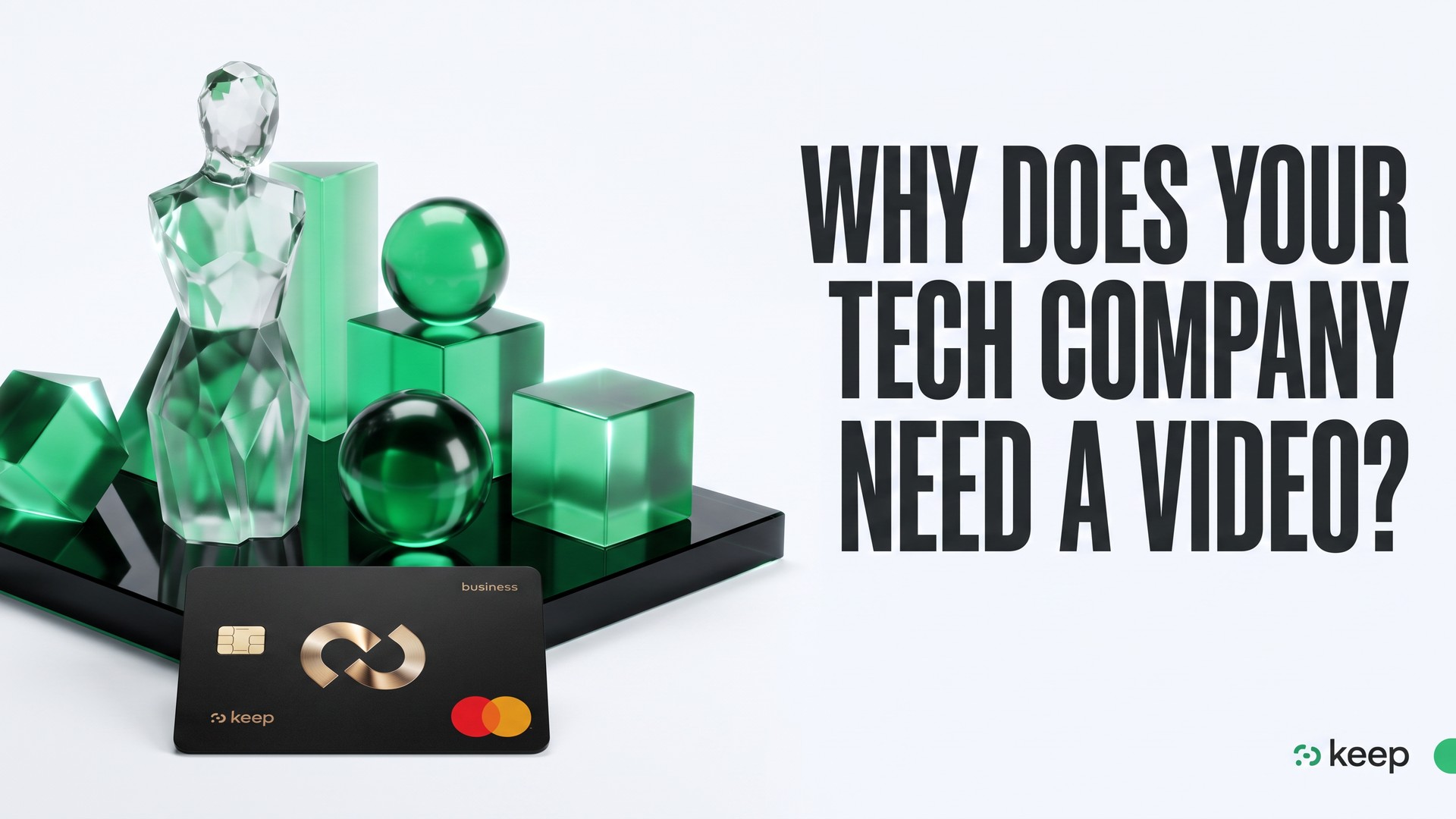
Spec ad · KEEP
It’s a fair question, and tech founders are right to ask it. You have a product that works, a site that explains it, and a demo that converts the people who book one. A film feels like the thing you do after the growth problem is solved.
Here’s the honest answer — four reasons that come up with almost every tech company we talk to — and then the harder part: what that video actually looks like when your product has no physical form. The film above is our own answer to that, a spec ad we built end-to-end for KEEP, an all-in-one business banking and payments platform.
1. Because nobody knows what you do.
Read your own homepage headline out loud. If it could sit on three competitors’ sites without anyone noticing, you have a comprehension problem, not a traffic problem. Software is abstract by nature — there is no shape, no weight, nothing to point at — so most tech copy retreats into category language: platform, unified, seamless, end-to-end.
Video is the fastest way out of that. In thirty seconds you can show a person the shape of the problem and the shape of the relief, and they will understand your company better than they would from four hundred words of positioning.
If your headline works on your competitor’s site, it isn’t doing anything on yours.
2. Because your feature list is identical.
In a mature category, spec parity is real. Your competitor has the integrations too. They have the dashboard, the API, the SOC 2 badge. If the buyer’s decision came down to the comparison table, half the companies in your space would not exist.
What isn’t identical is how a company makes someone feel about the work they do. That’s not a feature you can copy into a roadmap, and film is the only medium that delivers it at scale.
3. Because cold traffic doesn’t read docs.
Most tech companies are well supplied with demos, walkthroughs, and help-centre videos — and those work, on people who already decided to care. Point the same asset at a cold audience and it does almost nothing, because a UI tour answers how does it work for someone still asking why should I care.
That gap is usually where paid performance stalls. You want both kinds of asset, doing different jobs: a brand film that earns the first thirty seconds, and a demo that closes the person it sent.
4. Because someone has to forward it.
B2B software is rarely bought by one person. Your champion has to sell you internally to a finance lead, a security reviewer, and someone who has never opened your product. They cannot forward a feeling — but they can forward a link.
One well-made film does that job in every room you’re not in: the sales deck, the investor update, the careers page, the conference loop, the all-hands. It is the cheapest way to get an entire company telling the same story.
So what does that video look like?
This is the part tech companies find hardest, and it’s the reason we picked a payments platform to demonstrate on. A deodorant has a cap that catches light. A payments platform has… a dashboard.
You can’t film an API. So we stop trying to film the product and film what the product changes.
Find the metaphor
Every service does one true thing for its customer — not the feature list, the actual before-and-after. Our first job is to write that in one sentence, then find a single image that carries it.
For KEEP the sentence was: business banking is supposed to be clear, but the system you’re stuck in is rigid, and it’s holding you in place. The image was glass.
So we built the world out of it. A glass storefront, a glass tower, a glass aeroplane, a glass boardroom — and glass people moving through all of it. Everything green, translucent, beautifully lit, and completely rigid. You can see straight through this world and you cannot move inside it. That’s the feeling of the old system, rendered as an object.
Then break it
A metaphor is only worth building if you can break it. Halfway through, the glass fractures — a shoulder shatters and there’s skin underneath. The world turns real: actual people, an actual kitchen, an actual airport. The product isn’t the hero because its limits are higher. It’s the hero because it’s the thing that got you out.
Land the features last
Only once the story has done its work do we say what the thing does, plainly, one beat each — 10× higher limits, up to $1M in capital, expenses on autopilot, zero fees worldwide, pay in any currency, your business in your pocket. Same information a feature-first film opens with; completely different job, because by then the viewer has a reason to want it.
How we work with tech companies.
The process is the same whether you’re a payments platform, a dev tool, or a B2B SaaS nobody can pronounce:
- We learn the product properly. Docs, dashboard, positioning, the objections your sales team actually hears — looking for the one true promise underneath the feature list.
- We write the before-and-after. One sentence. If we can’t, the positioning isn’t ready, and we’ll tell you that first.
- We design the metaphor and the world. A visual system that belongs to you and no one else, in your brand colours, with your product at the centre.
- We produce it with AI and CGI. No location, no crew day, no talent booking — worlds that would cost a studio budget get built in the pipeline instead.
- We deliver the campaign, not a file. A hero film plus cutdowns for paid, social, and sales — 16:9, 1:1, 9:16 — and the key art that goes with it.
What we need from you is access and accuracy: the product, the brand, and the real numbers. Claims come from you and we keep them exactly as given — regulated categories especially.
Why this works for software
Because the constraint that hurts a tech company — nothing physical to shoot — stops mattering when the whole world is built rather than filmed. A glass city is no harder for us than a glass bottle. The ambition of the idea sets the ceiling, not the production budget, and you can test a new metaphor or a new market without going back to a set.
Disclosure. This is a spec advertisement — conceived and produced by AiM as portfolio work, not in partnership with KEEP. Any marks shown do not signify a commercial relationship between KEEP and AiM.
If you sell something people can hold, see how we approach the opposite problem in what is a product video — or start a project below.
Frequently asked
Why does a tech company need a video?
Because software is abstract and video is the fastest way to be understood. Four reasons repeat: nobody can tell what you do from a headline; your feature list reads like your competitor’s; cold traffic won’t read documentation; and your sales, careers, and investor story all need the same asset. One film solves all four.
Isn’t a product demo or screen recording enough?
A demo is documentation, not persuasion. It converts warm traffic well and does almost nothing for someone who’s never heard of you. Most tech companies have plenty of demo content and no brand film — then wonder why cold paid creative stalls. You want both, doing different jobs.
How do you make a video for software with no physical product?
You film what the product changes, not the product. We find one visual metaphor for the customer’s before-and-after and build a world around it. For KEEP it was glass — a rigid, transparent world that shatters when the product arrives.
Is this a real KEEP advertisement?
No — it’s a spec ad, produced by AiM as portfolio work, not in partnership with KEEP. It does not signify any commercial relationship between KEEP and AiM.
Send us your docs and a login. Book a 30-minute call and we’ll find the story in your product.